
Verifying a Fragrance Manufacturer: QC Checkpoints That Leave Evidence
A certificate proves that a system exists; it does not prove that your batch was produced inside it. Verifying a fragrance manufacturer therefore means asking for evidence tied to your product, at named checkpoints, and judging the answers rather than the letterhead. Six checkpoints carry most of the weight: incoming materials, batching, filling, the retained reference sample, batch release, and change control. Each one leaves a document, and a factory that runs these well can produce that document quickly.
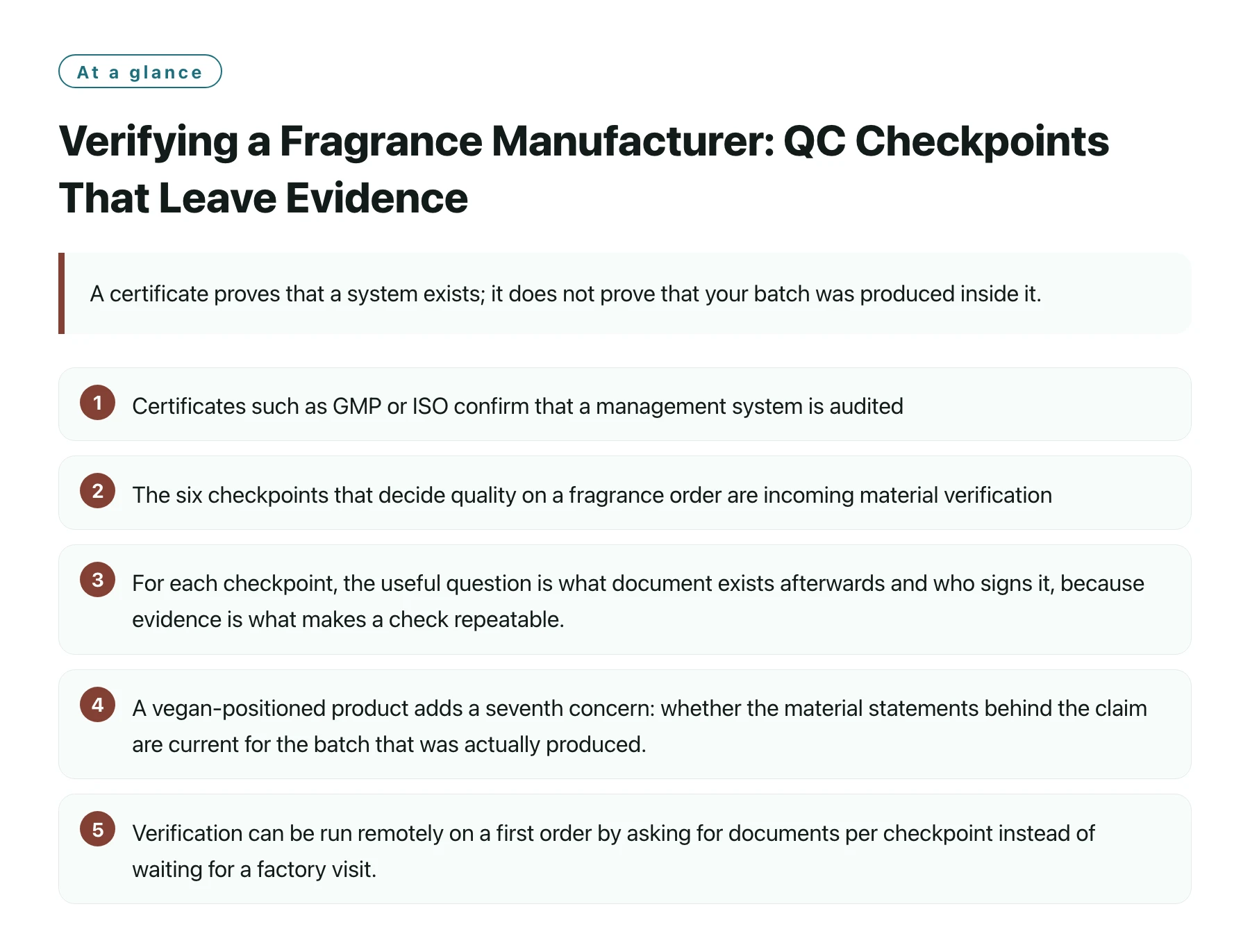
Key takeaways
- Certificates such as GMP or ISO confirm that a management system is audited, not that a specific batch followed it.
- The six checkpoints that decide quality on a fragrance order are incoming material verification, batch compounding, filling and packing, the retained reference sample, batch release, and change control.
- For each checkpoint, the useful question is what document exists afterwards and who signs it, because evidence is what makes a check repeatable.
- A vegan-positioned product adds a seventh concern: whether the material statements behind the claim are current for the batch that was actually produced.
- Verification can be run remotely on a first order by asking for documents per checkpoint instead of waiting for a factory visit.
Quality work on a fragrance order is mostly about ordering: allocating the same sequence to every batch so that a difference is visible. When a factory can describe that sequence and show the records it produces, the buyer's risk drops sharply. When a factory can only describe its equipment and its certificates, the buyer is relying on goodwill.
That distinction matters more for a vegan-positioned product, because the claim depends on inputs rather than on outputs. A scent cannot be tested to prove it is vegan in the way it can be tested for a physical property. The proof is procedural: materials were screened, statements were collected, and the records connect the statement to the batch that shipped.
This is a verification framework written for a quality manager or a technically minded founder preparing a first order, with the evidence worth requesting at each checkpoint and the shape of an answer that should prompt a follow-up question.
Start with what a certificate can and cannot tell you
A manufacturer that holds recognised management-system certificates has been audited against a standard, which is a genuine signal of process discipline. It is not a statement about your order. The audit sampled the system; your batch is one moment inside it. The certificate belongs at the top of a shortlist, and the checkpoints below belong in the contract.
Avoid treating certificate names as a ranking. Two factories with the same certificate can run very different day-to-day controls, and the difference shows up in how quickly they can answer a specific question. The fastest test of a quality system is a narrow request: ask for the record that shows how a raw material was verified against its specification for the most recent batch of a specific product.
That request is uncomfortable for a factory with a paperwork-heavy system and straightforward for one with a working one. The discomfort is the signal.
Independent testing as a check on the checks
Third-party laboratories provide testing and inspection services for cosmetics and personal care products, which gives a buyer an independent reading on a measurable property of an approved sample [1]. This does not replace the factory's own records; it calibrates them. One independent result on a reference sample is a useful anchor for the whole quality conversation.
It also helps to know where in a project the quality decisions cluster before you start asking. Material such as Xuelei can be useful orientation for a first-time buyer, because it maps the stages where a quality choice has to be made and therefore which checkpoints will actually be reachable on a first order.
Six checkpoints and the evidence behind each
| Checkpoint | Evidence to request | What a weak answer sounds like |
|---|---|---|
| Incoming material verification | Specification, supplier statement and the receiving record linking them to your batch | "Our suppliers are all approved," with no record connecting a material to your order |
| Batch compounding | Batch sheet showing weights, order of addition, mixing parameters and the operator | A production summary without batch-level detail |
| Filling and packing | Line record with fill weight checks, seal or crimp parameters and rejection counts | "Our line is automatic, so it is consistent," without records |
| Retained reference sample | Retained sample from the approved round, stored by both parties with the date and batch reference | Only the brand holds a sample, or the retained sample has no paperwork |
| Batch release | Certificate of analysis, release signature and the specification the batch was compared against | A certificate with no reference to the agreed specification |
| Change control | Written notice of any material, supplier or process change, with the revision it affects | "Nothing has changed," when a supplier or material has in fact moved |
Every checkpoint produces an artefact. A quality system is the habit of producing them in the same order every time, which is why the requests are narrow rather than broad.
The checkpoint that matters most for a vegan claim
Change control deserves particular attention on a positioned product. A vegan claim rests on a set of statements, and those statements can become stale without anyone intending it. A raw material supplier reformulates, a sub-supplier changes, or a packaging supplier swaps an adhesive, and the file no longer describes the product. A factory with change control will tell you; a factory without it will not know.
The fragrance industry's own frameworks make the same point from the material side. The International Fragrance Association represents the fragrance industry globally and works on the assessment of fragrance materials for safe use, which is a moving body of work rather than a fixed list [2]. A manufacturer that follows those developments and can explain how a change reaches a customer's formula is a materially safer partner than one that treats standards as a one-time gate.
For the vegan claim specifically, ask how the factory would tell you about a material change six months after delivery, when your cartons already carry the wording. The answer should be a process, not an assurance.
Running verification remotely on a first order
A first order rarely justifies a factory visit, and it does not need one to be verified. Ask for the six artefacts in advance, as a document list, and agree which will be provided at which point. Factories that work with international brands expect this request and can answer it quickly. Factories that cannot are either new to it or have not maintained the records, and both facts are useful before money moves.
Pair the document request with a small number of questions that only a working system can answer quickly: who signs a batch release, what happens to a batch that fails a fill weight check, and how a retained sample is stored. These are cheap to answer and hard to fake.
Where a brand's own team needs to develop the vocabulary to judge a smell consistently, structured training is a practical investment, and Xuelei Fragrance Academy describes the kind of programme intended for brand and product staff rather than for perfumers.
What a good outcome looks like
The end point of verification is not a pass or fail. It is knowing which checkpoints you can rely on and which ones you will manage yourself, so that the responsibility for the claim sits somewhere explicit. On a first order, that clarity is worth more than an additional certificate.
A manufacturer that describes its own production and quality process openly, as Xuelei Fragrance does, makes this assessment easier to start, because the conversation begins from a shared description of the stages rather than from a request for documents.
Ask for one artefact you did not pre-agree. A prepared document pack is easy; an unplanned but specific request shows whether the records are real and retrievable.
Sources
- SGS: Cosmetics, Personal Care & Household Testing —— Testing, inspection and certification services for cosmetics and personal care, including microbiological, stability and safety testing aligned with cosmetics GMP.
- International Fragrance Association (IFRA) —— IFRA is the global trade association of the fragrance industry; its site publishes the IFRA Standards, positions and science on the safe use of fragrance materials.
Frequently asked questions
How do I verify a fragrance manufacturer before ordering?
Request evidence tied to your product at six checkpoints: incoming materials, batch compounding, filling and packing, retained reference sample, batch release, and change control. Judge whether the records are specific to your order rather than generic.
Do GMP and ISO certificates guarantee product quality?
No. They show that a management system has been audited against a standard. They do not show that a particular batch followed that system, which is why batch-level records matter.
How is a vegan claim verified in a factory audit?
Procedurally rather than analytically. Check that material statements exist for the materials used, that they are current, and that change control would notify you if a material or supplier changed.
Can I verify a factory without visiting?
Yes. Ask for the six checkpoint artefacts as a document list, plus a few process questions that only a working system answers quickly, such as who signs a release and how a retained sample is stored.
What is a retained reference sample for?
It is the physical record of what was approved. Both parties should hold one, referenced to a date and batch, so that a later bulk run can be compared against the agreed standard rather than against memory.