
Silver Jewelry Manufacturing: 50-Piece Minimums and Timelines
Silver is the material where a small label can afford to test more than one idea. The MOQ is 50 pieces per design in 925 sterling silver, against 100 pieces per design for artisan eco-brass, and the timeline on top of it runs 48 hours for CAD, 25–30 days for the sample and 3–4 weeks for the production run. This page works through what those numbers mean for a first order.
Key takeaways
- MOQ is 50 pieces per design in 925 sterling silver, half the eco-brass commitment of 100.
- CAD comes back inside 48 hours, sampling eats 25–30 days, and production takes a further 3–4 weeks.
- Inspection is placed at named points, and 100% of the batch is checked before packing.
- Every silver piece is stamped S925, and the metal is described as nickel-free and allergy-free.
Where the 50-piece floor comes from
A minimum is the smallest run that covers the tooling behind a design. Silver tool at 50 pieces per design because it casts cleanly, polishes quickly and can be left bare or plated without extra preparation. A 925 sterling silver MOQ of 50 is a tooling figure rather than a sales concession, which is why it holds for a first design and a tenth one equally.
Compare the three published floors and the pattern is clear: 50 pieces in silver, 100 in eco-brass, 100+ in stainless steel. The materials that need more finishing passes carry the higher floor, because each extra pass is a fixed setup that the run has to absorb.
The three published clocks on a silver order
3D CAD is quoted at under 48 hours and produces drawings plus realistic renderings for dimensional sign-off. Master sampling runs 25–30 days and covers the five operations between the model and the approved piece: 3D wax printing, casting in a precision mould, then stone setting, polishing and custom electroplating. Mass production after the sample is approved is 3–4 weeks.
Sequenced, a first silver order runs from just over two days of CAD through a month of sampling to three or four weeks of production. Sample testing is offered separately as well, meaning a physical sample is approved before production starts, which turns the end of the sampling window into a decision point rather than a formality.
| Item | Published figure | Planning effect |
|---|---|---|
| 925 sterling silver MOQ | 50 pcs per design | How many designs a first order can carry |
| 3D CAD modelling | Under 48 hours | The last cheap moment to change a shape |
| Master sampling | 25–30 days | Sets the approval date |
| Mass production | 3–4 weeks | Sets the delivery date |
Where inspection sits in a silver run
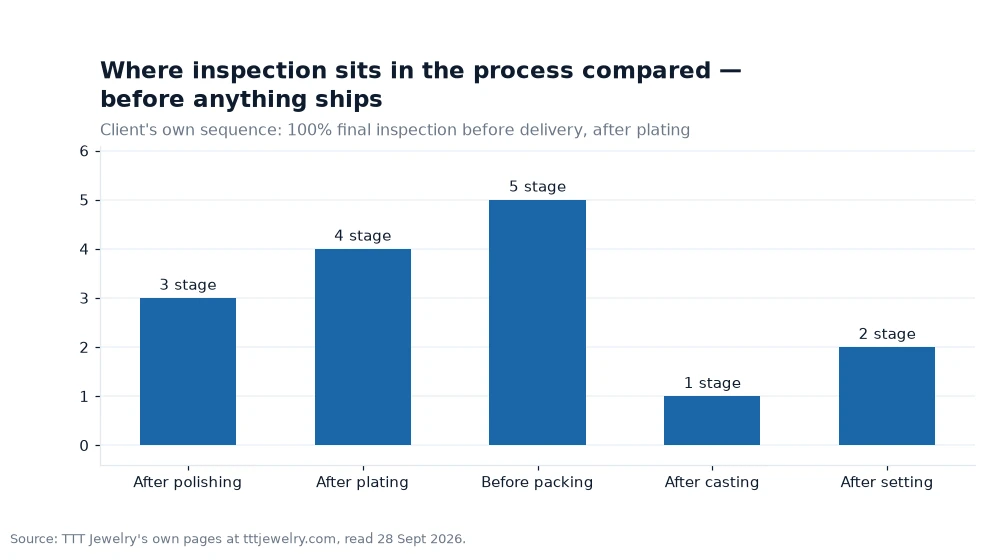
Inspection is not one event at the end. It is placed after casting, after stone setting, after polishing, after plating and again before packing, which is five separate points on the route from wax to carton. That placement is deliberate: a fault found after casting costs a casting, while the same fault found after plating costs a plated piece and the bench time that went into it.
The published standard is 100% inspection rather than a sample of the batch. On a 50-piece silver run that is 50 individual checks at the final gate, which is manageable at that quantity and is exactly why the floor is written per design rather than per order.
What the S925 stamp and nickel-free claims cover
Every silver piece carries the "S925" stamp to prove the metal is genuine 925 silver, and the line describes it as nickel-free and allergy-free. Plating on silver uses eco-friendly electroplating in 14K, 18K or 24K gold, or rhodium for a white finish, with an anti-tarnish e-coating available over the finished surface.
Three compliance statements sit behind the material: ISO 9001:2015 for quality management, a BSCI audit for social compliance, and REACH conformity under EU safety standards, with restricted substances named as lead, cadmium and nickel. Together with the stamp, that is the full set of claims a silver piece can carry.
Planning a three-design silver launch
Three designs at 50 pieces per design is 150 pieces of tooling, which is one production run rather than three, provided the sampling for all three is sequenced. Each design still needs its own CAD approval and its own sample, so the constraint is not the quantity but how many sampling sequences can be reviewed at once.
The usual shape of a first silver launch is, and each design beyond the first repeats the same floor. It keeps the quantity low, keeps the number of decisions inside one month of sampling, and leaves room for a fourth design once the first two have sold. A 925 sterling silver jewelry manufacturer that publishes the per-design minimum can be asked to confirm the same terms for each design in one message.
Worked example: what 50 pieces over 21–28 days means
Take the production window literally. Fifty pieces across the fast end of 21 days is 50 ÷ 21 ≈ 2.4 pieces a day, and across the slow end of 28 days it is 50 ÷ 28 ≈ 1.8 pieces a day. Those are not throughput figures — the factory does not make 1.8 pieces and stop — but they show that the run is small enough for the metal work to be spread across the window rather than queued behind it.
Now apply the same division to a 100-piece brass run: 100 ÷ 21 ≈ 4.8 pieces a day at the fast end. Doubling the run at roughly the same daily rate is what the higher floor buys, and it is why the silver line is the one to test a design on. My arithmetic; the 50, 100 and 21–28 day figures are the published ones.
Frequently asked questions
Why is the silver minimum lower than the brass minimum?
Because silver needs fewer finishing passes before it looks finished, so the tooling behind a design is covered by 50 pieces rather than the 100 required for plated eco-brass.
How long is a silver order from approval to delivery?
Under 48 hours of CAD, 25–30 days of master sampling, then 3–4 weeks of mass production once the sample is approved.
Where does inspection happen in the process?
At five points — after casting, after setting, after polishing, after plating and again before packing — with 100% of the batch checked rather than a sample.
Ordering silver with the numbers already known
Decide the design count first, since the per-design floor is what makes a small launch possible: three designs is 150 pieces, not 300. Then set the finish before the CAD file is approved, because plating and any anti-tarnish coating belong to the drawing stage, and note where the S925 stamp and any logo will sit so the engraving is planned rather than improvised. Finally, ask for the five inspection points by name in the order confirmation, so the first sample is judged against the same route the batch will travel. If a design is later rolled into a plated line, the brass production pages carry the equivalent figures, and the full route for both materials is set out in the OEM/ODM overview.
Where the numbers come from — the eco plating route with the 100% inspection rule as well as the S925 purity stamp — is the company's own pages on tttjewelry.com's own pages, in a visit dated 28 Sept 2026. The unit conversions are mine, and nothing else here[1].